Reference
Fiber Goal and How to Hit It
Fiber is the part of plant foods that your body cannot fully break down, and most adults in the United States do not eat nearly enough of it. This guide states the target amounts, explains why fiber is worth hitting, and gives concrete ways to reach it without dramatic diet changes.
The daily fiber target, in grams
Fibre, spelled fiber in U.S. usage, is the part of plant foods that your small intestine cannot digest. Because it arrives in the colon largely intact, it is fermented by the bacteria that live there, and that fermentation is behind most of what fibre does for you. Unlike protein, carbohydrate and fat, fibre is not counted as an energy source in the usual 4-4-9 system, even though it sits inside the carbohydrate line on a Nutrition Facts label.
The Adequate Intake set by the Food and Nutrition Board of the National Academies, which the National Institutes of Health Office of Dietary Supplements publishes, is a daily total rather than a per-meal target. For adults ages 19 through 50 it is 38 grams per day for men and 25 grams per day for women. Over age 50 the numbers fall to 30 grams for men and 21 grams for women, because average energy needs decline. Pregnancy and lactation change the figures again, upward in lactation. The Daily Value used on U.S. food labels is 28 grams per day, which is roughly the midpoint of those recommendations and is the number printed on packaged food.
The World Health Organization frames the same idea as a floor rather than a target: its healthy diet fact sheet recommends at least 25 grams of naturally occurring fibre per day for adults, from fruit, vegetables, legumes and whole grains, and at least 400 grams per day of fruit and vegetables combined for people over age 10. Four hundred grams is about five portions of 80 grams. For children, WHO gives about 15 grams per day between ages 2 and 5 and about 21 grams between ages 6 and 9, scaled to energy needs.
- Men 19 to 50: 38 g per day
- Women 19 to 50: 25 g per day
- Men over 50: 30 g per day; women over 50: 21 g per day
- FDA Daily Value on labels: 28 g per day
- WHO floor for adults: at least 25 g per day, plus at least 400 g of fruit and vegetables
What the gap actually looks like
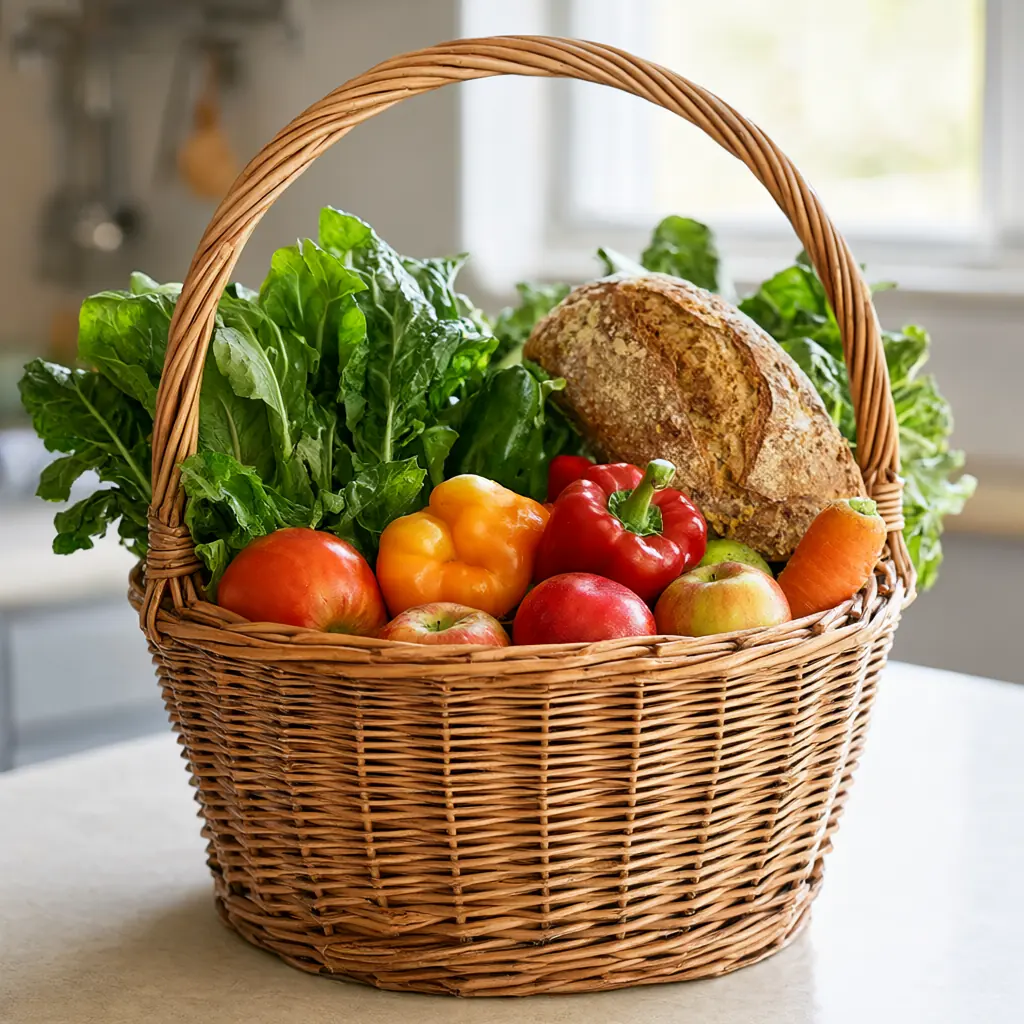
The shortfall is not mysterious. Fibre lives exclusively in plant foods: vegetables, fruit, legumes, nuts, seeds and whole grains. A day built around refined grain, animal protein, cheese and something packaged has almost nowhere for fibre to come from. Raising the number is therefore mostly a matter of changing which items appear at meals, not of eating larger portions of the same items.
Soluble, insoluble and fermentable
A label generally reports total fibre, sometimes with a line for insoluble and soluble fibre underneath, and it does not tell you how much is added versus intrinsic. Added isolated fibres such as inulin, chicory root fibre, maltodextrin or gum arabic appear on the label and can raise the fibre number substantially without changing the food's plant content in the way that whole vegetables, fruit, legumes and whole grains do. Harvard T.H. Chan School of Public Health notes that whole plant foods deliver fibre together with a wide range of other nutrients and phytochemicals, so the fibre number is easiest to act on when it comes from plants rather than from a single isolated ingredient.
Getting there with ordinary food
Combining four of those items in a day gets most adults past 20 g without effort: oat breakfast plus an apple plus a half cup of beans at lunch plus an evening vegetable. Three habits close the rest: switch refined grain for whole grain, which the label makes easy because whole grain should be the first ingredient; eat legumes several times a week; and keep fruit and vegetables in the number of portions WHO recommends, at least 400 g a day combined.
Increase gradually over two to three weeks and drink ordinary amounts of fluid. Bloating and gas are the usual reason people abandon the change, and they are largely a matter of speed, because the bacterial population that ferments fibre takes time to adjust. The discomfort usually settles. People with a condition that limits fibre, such as inflammatory bowel disease during a flare or a prescribed low-residue diet before a procedure, should follow the specific advice they were given rather than a population figure, and anyone whose digestion changes persistently and unexplainedly belongs with a clinician rather than with a reference page.
- Beans and lentils: about 8 g per half cup cooked
- Raspberries: about 4 g per half cup; pear or apple with skin: about 4 to 5 g
- Chia seeds: about 7 g per 2 tablespoons
- Whole-wheat pasta: about 6 g per cup cooked; oats: about 4 g per half cup cooked
- Add fibre over two to three weeks rather than all at once
Updated 2026-10-07