Reference
Protein Goal Per Day
Protein is the macronutrient most people try to count, and most people are unsure of their number. This guide starts with the minimum the U.S. government recommends, explains when a higher target is sensible, and walks through how to calculate a daily gram goal from your own weight.
The recommended minimum
The Dietary Reference Intake for protein set by the Food and Nutrition Board of the National Academies is 0.8 grams of protein per kilogram of body weight per day for adults. The National Institutes of Health Office of Dietary Supplements states this figure in its protein fact sheet, and it is the same value used by the 2020-2025 Dietary Guidelines for Americans. For someone weighing 70 kg, which is about 154 pounds, the arithmetic is 70 x 0.8 = 56 g of protein a day. At 90 kg, or about 200 pounds, it is 72 g a day. Note that the figure scales with body mass, not with ideal body weight, and it is written per kilogram, so converting pounds to kilograms first, by dividing the pound value by 2.2, is the step most people skip.
The word that gets lost is minimum. A Dietary Reference Intake is the amount estimated to cover the needs of nearly all healthy people in a group, about 97 to 98 percent, and it is not a target for optimising body composition, appetite, or the maintenance of muscle as you age. Harvard T.H. Chan School of Public Health's protein coverage makes the same distinction, pointing out that the RDA is a floor and that many people do well above it. The Acceptable Macronutrient Distribution Range in the Dietary Guidelines spans 10 to 35 percent of daily calories, which at 2,000 Calories is 50 to 175 grams, so a daily intake of 100 to 130 grams is well inside the published range and not an extreme number.
How much food that actually is
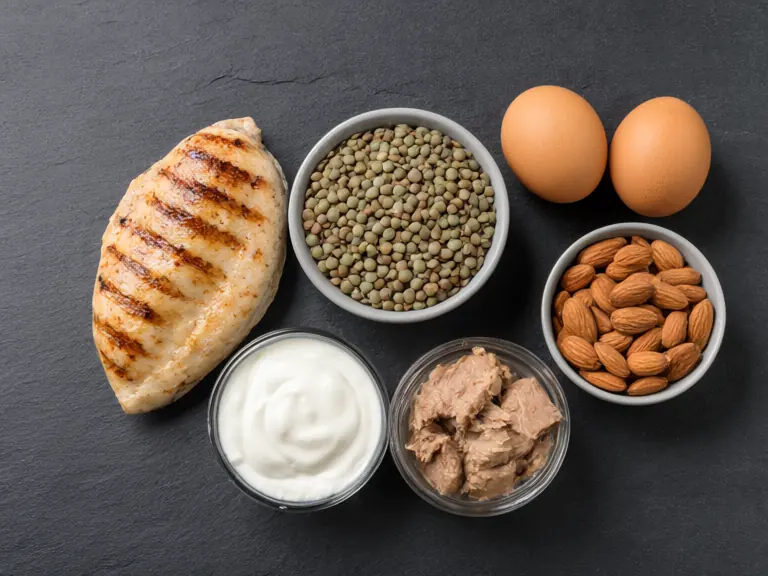
Gram targets only become useful when you can see them in ordinary portions. The values below are typical for cooked portions as they are commonly served, and they vary with cut, brand and recipe, so treat them as an order of magnitude rather than a label.
- Chicken breast, 3 ounces cooked: roughly 26 g of protein
- Lean beef or pork, 3 ounces cooked: roughly 22 g
- Canned tuna, 3 ounces: roughly 20 g
- Salmon or other oily fish, 3 ounces cooked: roughly 19 g
- Two eggs: roughly 12 g
- Milk, 1 cup: roughly 8 g; plain Greek yoghurt, 1 cup: roughly 20 g
- Dried beans or lentils, 1 cup cooked: roughly 15 to 18 g
- Firm tofu, half a cup: roughly 10 g; tofu sold as firm or extra-firm varies widely, so read the label
Spreading protein across the day
Food mix matters most where individual plant foods are the mainstay. Animal foods contain all nine essential amino acids in proportions the body can use directly. Individual plant foods are often lower in one or more of them, legumes in methionine and grains in lysine, but a varied plant pattern that includes legumes, grains, nuts and seeds over a day supplies the full set; the older idea that specific pairings had to appear in the same meal has been dropped. The 2020-2025 Dietary Guidelines describe beans, peas and lentils, nuts, seeds, soy products and eggs as protein foods alongside meat, poultry and seafood, which reflects the same conclusion.
Working out your own number
Start with the floor and then reason upward from your situation. Convert your weight to kilograms by dividing pounds by 2.2, multiply by 0.8 for the minimum, and write that number down as the line you should not be under. If you resistance train regularly, are older and want to keep strength, or are eating in an energy deficit and want to keep lean mass, a number in the region of 1.2 to 1.6 g per kg is a common and reasonable choice, and it stays inside the 10 to 35 percent Acceptable Macronutrient Distribution Range for most calorie intakes. Above roughly 2 g per kg, additional protein displaces carbohydrate and fat from the calorie budget and has no clear further benefit for healthy adults, so the extra grams are usually better spent elsewhere.
Finally, treat any figure as an estimate you test rather than a rule you obey. Re-run the arithmetic after a meaningful weight change, since the target is proportional to body mass. Look at the whole diet rather than a single nutrient: protein targets that crowd out fibre, fruit, vegetables and whole grains tend to cause more problems than they solve, and those are the food groups the Dietary Guidelines and WHO both tell people to increase. If you have kidney disease or another condition that changes how protein is handled, the appropriate number is a clinical question and belongs with your own clinician rather than with a population reference value.
Open the BMR and TDEE Calculator
Updated 2026-10-07